25 Jul 2017

Collecting the data to prove the benefits of REHAP products

Work is now underway to perform detailed life cycle assessment of the social, economic and environmental benefits of the planned REHAP products. This work will examine every step of the processes involved in taking the raw bio-material to a green product to be used by the construction industry. Giorgio Urbano of Italian firm D’Appolonia is leading this work and here explains progress being made at the start of the project.

Some of the first activities in the REHAP project to start producing concrete results are those related to assessing the energy, technological and economical impacts of the materials being developed for the final bio-products, all along their life cycle from raw material to final product. This vital work is being done in Work Package 6, which has defined some clear objectives:

  • To define a set of key performance indicators (KPI) for the environmental, social and economic impact evaluation of the REHAP processes.
  • To carry out market analysis of competitive materials and products on the market • To manage the Life Cycle Assessment (LCA), Life Cycle Costing (LCC) and Social Life Cycle Assessment for the different technologies
  • To perform integrated environmental, economic and social assessment of the REHAP bio-based building panel
  • To lead resource efficiency studies for further processes optimisation

This work is being led by Giorgio Urbano of D’Appolonia, which will specifically evaluate the environmental, economic and social impacts of Rehap bio-based processes through Life Cycle Assessment (E-LCA), Life Cycle Cost Analysis (LLCA) and Social Life Cycle Assessment (S-LCA).

These assessments will be further used as a starting point to evaluate the environmental, economic and social impacts of the developed bio-based building panels. The work will also involve comparing the REHAP panels to conventional non-renewable building panels available on the market, which offer similar performance credentials. REHAP expects that the environmental and cost benefits of its panels will then form the basis of a commercial business plan that will enable their penetration into the market as a viable green building solution.

Later on in the project, a full market analysis will also be performed to ensure that the pricing for the REHAP panels is competitive compared to the fossilbased alternatives and other bio-based alternatives already on the market.

“This work has now started in the project,” says Giorgio Urbano. “We need to develop a product that has positive economic, environmental and social impact. Every partner in the project is providing a piece of this bigger picture, so we need to start now and collect all these inputs and data to make sure that we build the right final product. By analysing the impact of each part of the process, we will be able to do that.

“So, in order to have an accurate assessment of the total impact of the final product, we need to have all the inventory data, starting with the raw material and passing through the entire processes including the final production of the panels,” he explains further.

“For example, in the green cement, we need a plasticizer that is made with some bio-based materials, but we have to produce these biobased materials in the first place. To produce these, we need lignin and to have this lignin we need straw – the base material that starts the whole thing off and where we start our LCA.”

At this stage of the project, the work being done by D’Appolonia is in the scoping phase, where the team is defining the pathways for the materials and processes towards the final product and how these interact as well as the interdependencies of the various aspects of the work within the project by other partners.

“Part of the task ahead, therefore, is to build a map indicating where the interactions between data, partners, processes and materials lie. We have now built this map,” explains Urbano.

“We started with the project descriptions, describing the activities of each partner and collecting the data provided from them for each process step for the four products being developed. We started with simplified blocks for a diagram, in which material flows were included. Then we identified the responsible partner for each of the project stages and looked at how they would be providing the related data, to assess the environmental, economic and social impact of the target processes.

“We have also started to define the table of contents related to the market analysis; what could be foreseen for month 18, for example and so, we have provided this structure, where each responsible partner will be in charge of providing some market data about a competitive product in order to evaluate the market potential for each of the intermediate products.”

With the framework in place, the next stage is to start collecting the data, split into blocks of time within the project, from the first phase, which is the research phase, approaching the finish and development and the second phase which is the processing, scaling up and demonstration.

“We will perform an intermediate as well as a final environmental and economic impact study based on the scaling up approaches; trying to understand what could be the environmental impact in a large-scale production; even if this large-scale production is not in operation, but just on paper,” explains Urbano.

“The only thing that we are missing in the description of the activities so far is the selfsufficiency studies that are also being developed in WP6; so, in parallel with the LCA, the LCC and social lexical analysis, we are going to develop around four resource efficiency audits of the final outcomes.

“Up to now, the mapping and categorising of all the processes is going to be used for both actions. The foreseen action will be to categorise a benchmark for the different processes and to provide the studies and suggested efficiency measures.

“The project is seeking to provide an environmental benefit in the processes and products being developed in terms of a lower use of fossil-based resources,” concludes Urbano. “The target is set on 80-100 per cent less fossilbased resources used and shorter emission and energy consumption up to 30 per cent.

“So, while we are expecting the project to provide these environmental and economic benefits we don’t have enough data at the moment to make these claims. That is what we hope to provide.”
12 Jun 2017

SPIRE – The Public Conference.

Between the 19th and 21st of September 2017 the Process Industry Conference, a SPIRE mid-term policy event, will be taking place in Brussels, Belgium. It is intended to gather all relevant stakeholders together for the European Process Industry.

The Public Conference –

On day one the Brokerage and thematic discussion meetings, which are usually reserved for A.SPIRE members, will be taking place. Although with this being such a highly publicised and anticipated event it has been decided it will be open to members of the public for the 19th of September only. After which, for the final two days, it shall revert to A.SPIRE members only.

Also within day one (19th) it shall be dedicated to picturing the future EU Process Industry and what can be implement if the appropriate investments and funds are met. In addition, the SPIRE projects’ day organisation will be included on this day, of which all SPIRE projects are invited to the pitching session

A Programme on the Conference will be distributed shortly.

Event Address: BluePoint Brussels business centre, Boulevard Auguste Reyers 80, 1030 Brussels, Belgium

For more information contact – info@spire2030.eu

03 May 2017

Second partner meeting has started beneath the Finnish sun

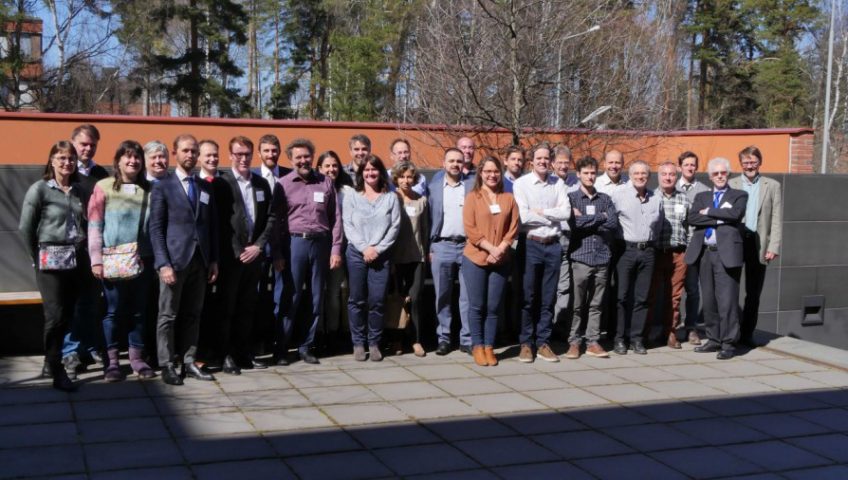
The second Rehap consortium meeting began today in Espoo in Finland, where the the partners gathered at the offices of VTT.

The meeting has been very fruitful so far with the focus being on the life cycle analysis of all value chains leading from selected bio materials to the four main Rehap bio-products.

The afternoon session focused on project communication and dissemination and the work done so far in raising the profile of Rehap as well as highlighting the commercial opportunities of the bioeconomy.

Further sessions will include updates on the work being carried out by the remaining partners, while a visit to one of the impressive VTT labs has also been arranged.

More info surrounding the event will follow but in the meantime please follow us on twitter 

28 Apr 2017

The indispensable role of biomass – EUBCE 2017

Insight, the dissemination work package leader of Rehap is delighted to be presenting the project at the European Biomass Conference and Exhibition – EUBCE 2017 next week. The event, which takes place in Stockholm on June 12-15, is celebrating its 25th year with a full agenda of horizontal topics making it the premier forum for the biomass and bioenergy community, cutting across research, industry and policy.

The EUBCE programme includes 1,004 presentations, with a main focus on the evolving international policy debate about tackling climate change. The event will also provide a platform for the most innovative scientific and technical advances and industry projects.

One of the key aims of the conference will be to examine how to close the gap between research achievements and industrial implementation, given that research in many areas has advanced considerably over the last decade.

Insight is coordinating a new H2020 project called BIOWAYS, a communications-focused project that will promote the huge potential of bio-based research results and raise public awareness of bio-based products, by developing a variety of communication techniques and through public engagement activities and the development of educational tools and materials.

“EUBCE 2017 will be a fantastic opportunity for projects attending to become involved in BIOWAYS and take advantage of the techniques and platforms being developed that will help them achieve this vital transition from research to industrial implementation,” says Insight MD and BIOWAYS coordinator William Davis.

EUBCE will also tackle the "The Indispensable Role of Biomass" as part of the long-term goal agreed at the Paris climate summit of limiting the increase of global average temperature and bioenergy in the wider bio-economy. Biomass potential, bioenergy policy targets for 2030 and beyond will also be part of this debate.

Sessions will also address some of the major challenges that the biomass community is facing today such as bioenergy, the production and utilisation of biofuels and different potential biomass feedstocks, including the organic fraction of municipal waste, the recent findings in the field of thermochemical biomass conversion technologies as well as the challenges and opportunities of establishing bioconversion processes for the bio-based economy.

Key approaches for the integration of bioenergy technologies implemented in a flexible manner to provide energy output on demand as well as the latest developments of large-scale industrial plants processing biomass residues and wastes to biofuels and bioenergy will also be presented and discussed.

The conference will conclude by debating how to "achieve the transition from research to industrial implementation". Important issues will be tackled during the conference, such as biomass production for energy integrated into food and feed farming, integration of bioenergy into a bio-based economy and that of bioenergy with other energy sources.

Insight will be working with EUBCE to promote the event and will be covering the issues debated throughout. As a leading dissemination consultancy specialising in this sector, Insight is currently working with several EU-funded projects working in this field including BIOWAYS and now Rehap, an new H2020 effort which aims to provide a systemic approach to reduce energy demand and CO2 emissions of processes that transform agroforestry waste into high added-value products.

12 Apr 2017

Raw material potential for biopolymers in Europe

LCM conference 2017

Category: Raw materials supply chains in the light of the circular economy

Title: Raw material potential for biopolymers in Europe

Authors: Andrea Thorenz, Lars Wietschel, Axel Tumaa

Resource Lab, University of Augsburg, Universitaetsstr. 16, 86159, Augsburg, Germany

Abstract

In the last years the biobased chemical industry is characterized by a strong growth. Many innovative products and materials like biopolymers have been developed. Europe’s demand for biopolymers is among the largest of the world and exceeds the domestic supply. Main sources for biopolymers are agroforestry residues. Therefore, biogenic renewable raw materials are the basic materials for a future oriented bioeconomy. Due to their arisings, wheat straw, maize stover and bark from coniferous and broadleaf are of special interest for establishing a bioeconomy in Europe. To get an understanding of available biomass amounts, competitive utilizations like straw as soil conditioner, as resource for livestock farming or the use for energetic purposes have to be evaluated. Besides this, any competition to the food production has to be avoided.

For the design of industrial processes, a detailed knowledge concerning the supply potential of different sources of agroforestry residues is needed. This covers the quantification of arisings of various sources of agroforestry waste as well as their regional distribution.

Methodologically, the analysis of the raw material potential is based on a detailed evaluation of EUROSTAT and FAO databases combined with a state-of-the-art literature review. In a second step, a material flow analysis is applied to assess and structure contemporary concepts of residue management with a presentation of competitive applications and their contribution to existing life cycles. For the design of a sustainable bioeconomy, potential variations of future arisings have to be evaluated. Therefore, a quantitative approach based on statistical methods like regression analysis is applied.

As a result of the research, we present sustainably available potentials of selected agricultural and forestry residues on regional level in the EU. Information about regional supply and demand of biomass will be crucial for upscaling successfully launched bioeconomic processes.

Keywords: biopolymers, agroforestry waste, state-of-the-art, material flow analysis, EU, statistical methods

[1] EU-Project REHAP: Systemic approach to Reduce Energy demand and CO2 emissions of processes that transform agroforestry waste into high added value products. Horizon 2020. No. 723670.

15 Jan 2017

The Role of Bioeconomy in the Circular Economy – Taking circularity beyond waste

On 12 January 2017, the European Bioeconomy Alliance (EUBA) participated in a meeting in the European Parliament hosted by MEP Miapetra Kumpula-Natri and MEP Miriam Dalli, Vice-Chairs of the European Parliament Intergroup on “Climate Change, Biodiversity and Sustainable Development”.

The Circular Economy Package is one of the currently most debated files at European level. Stimulating Europe’s transition from a linear towards a circular economic model, and closing the loop of product lifecycles are the driving ambitions of the EU institutions. Furthermore, in recent years the bioeconomy has become a policy priority in Europe, as it encompasses the sustainable production and use of renewable resources to produce every day products from food to car parts. The Commission’s Circular Economy proposal must be seen as an opportunity to link the circular and the bio-based economy.

The meeting started with a little quiz to test participant’s knowledge about the bioeconomy and was followed by a presentation on the EUBA on the links with the circular economy and with EU policy objectives. Some concrete examples of circular bio-based products, such as a coffee cup made from coffee waste, were shown to the participants.

Subsequently, Prof. Erik Matthijs (Katholieke Universiteit Leuven), chair of the 4th SCAR foresight Expert Group, gave his views on an efficient and sustainable bioeconomy, reiterating the need for a coherent integrated policy framework.

More information can be found on the event's webpage.

MENU