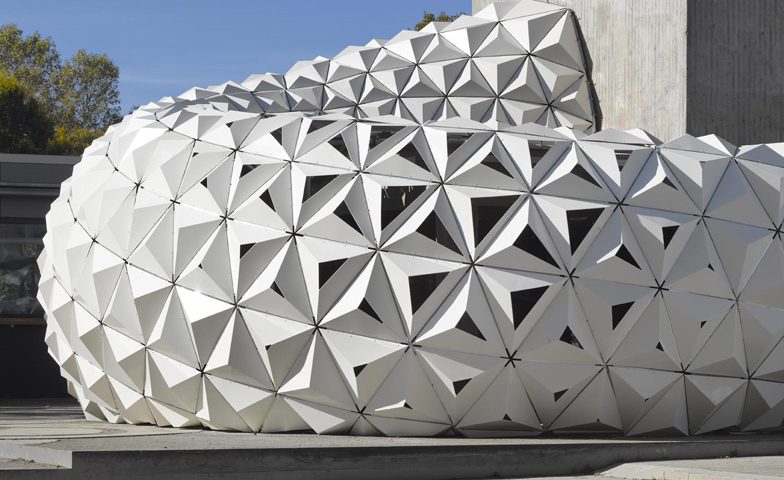
The spiky modules used to build this curving pavilion in Stuttgart, Germany, are made from a bioplastic containing over 90 percent renewable materials (photography by Roland Halbe).
Students and professors from Stuttgart University's ITKE (Institute of Building Structures and Structural Design) designed the freeform facade to demonstrate the structural properties of a new bioplastic developed specially for use in the construction industry.
Bioplastics are plastics made from renewable biomass sources such as starches, cellulose or other biopolymers, that offer sustainable alternatives to plastics derived from fossil fuels. The bioplastic used in the ArboSkin project is called Arboblend and is produced by German firm, Tecnaro, by combining different biopolymers such as lignin – a by-product of the wood pulping process – with natural reinforcing fibres.
"Thermoformable sheets of bioplastics will represent a resource-efficient alternative [to oil-based plastics, glass, or metal] in the future, as they combine the high malleability and recyclability of plastics with the environmental benefits of materials consisting primarily of renewable resources," explained the project team.
The pyramidal modules are made by extruding bioplastic granules into sheets before thermoforming them to create the faceted shapes and trimming off the excess material.
The double-curved skin is formed by linking the pyramids together, with bracing rings and joists helping to create load-bearing walls.
CNC-milling was used to remove sections from some of the modules, creating apertures in the facade. The waste material from this process can be re-granulated and fed back into the production process, while the plastic sheets can be composted at the end of their life.
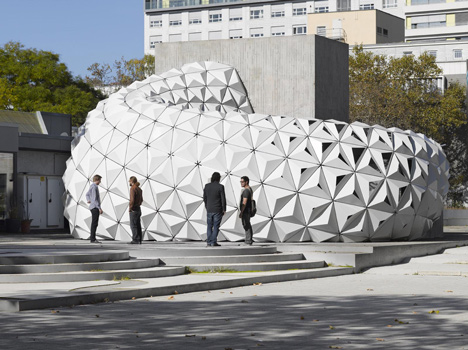
Mock-Up: The bioplastics facade mock-up was created within the framework of the Bioplastic Facade Research Project, a project supported by EFRE (Europäischer Fonds für Regionale Entwicklung / European Fund for Regional Development). It demonstrates one of the possible architectural and constructional applications of bioplastic materials developed during the course of the project. The blueprint is based on a triangular net composed by mesh elements of varying sizes.

Article sourced from: www.dezeen.com/2015/11/11/peter-marigolds-pocket-sized-formcard-mouldable-plastic-glue-bioplastic-design-kickstarter/

